🎵 Key Takeaway
If you only use "Tu, Tu, Tu," your music will sound like a robot. To play ballads and emotional songs, you need to expand your vocabulary. Learn the "Du" (Soft Tongue) and the "Hu" (Breath Attack) to soften your sound.
Imagine speaking a language where you only shout. That is what it sounds like when you use hard tonguing ("Tu") for everything.
Great ocarina players are like great singers. They know when to be punchy, and when to be whisper-quiet. Here is how to change your "accent."
1. The "Du" (Soft Tonguing)
Instead of hitting your teeth with the tip of your tongue (Tu), try hitting the roof of your mouth gently with the flat part of your tongue.
Say the word "Dune". Feel how soft the "D" is?
Use this for: Love songs, lullabies, and slow Ghibli tunes.
Sensitive Response
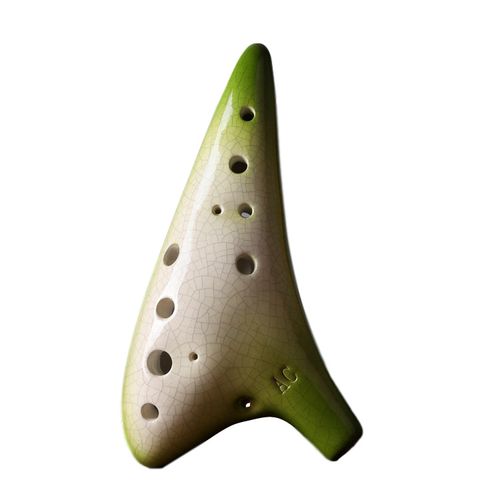
Soft tonguing requires an instrument that responds to very light air pressure. The Gradient Green Ocarina is famous for its responsiveness. It speaks clearly even when you whisper "Du," making it perfect for emotional playing.
Shop Gradient Green →
2. The "Hu" (Breath Attack)
This is the "No Tongue" technique.
Start the note simply by exhaling, like you are fogging up a mirror. "Hoooo..."
This creates a soft, fading-in effect (like a violin bow slowly touching the string). It eliminates the "pop" sound at the start of the note.
Warning: This is hard to time correctly. Practice it on long notes first.
3. Articulation on Multi-Chamber Ocarinas
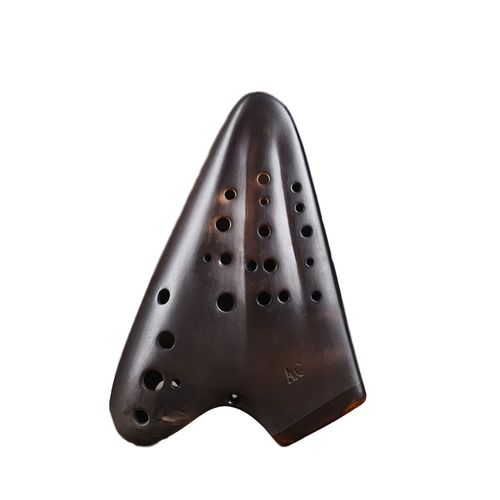
When you upgrade to a Triple Ocarina, articulation becomes even more critical.
When you switch chambers, if you don't tongue clearly, you will get a "smear" sound. You need a crisp "Tu" to hide the sound of the instrument moving across your lips.
The Pro's Challenge
Mastering articulation is the key to unlocking the Triple Ocarina. With its wide range and multiple chambers, your tongue acts as the conductor, ensuring every note is distinct and clean across all 3 octaves.
View Triple Ocarina →
Summary
Mix it up. In one song, use "Tu" for the fast parts, "Du" for the melody, and "Hu" for the ending. This is called "Musicality."