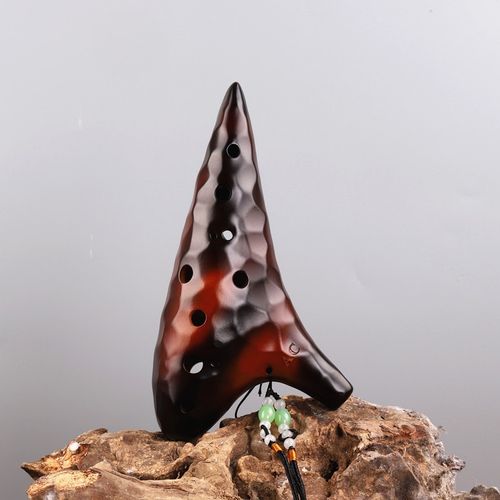
Welcome to the Eidolove Ocarina History lesson! When you pick up an Ocarina, the number of holes beneath your fingers is the key factor determining how wide a musical range you can play and how complex the music can be.
The design of the Ocarina's hole count has not been static; it reflects an evolution from simple toys to professional instruments over thousands of years. Let's explore the Ocarina Hole Count History and understand why the 12 Hole Ocarina became the global standard.
I. 🏺 Primitive Limitations: 2 to 6 Hole Ocarinas
The Ocarina's earliest forms were intended for simple sound-making and ritual needs, rather than complex musical performance.
Minimalist Structure: Ancient Mesoamerican and early European ocarinas typically featured only 2 to 4 finger holes. They were essentially simple whistles, capable of playing only a few notes with a very limited range.
Pendant Ocarinas: Modern 4- or 6-hole Pendant Ocarinas are the descendants of this primitive design. They are mainly used for simple melodies or as necklaces, with a range that usually does not exceed one octave.
The Core: Fewer holes in primitive ocarinas meant a narrow musical range, preventing the playing of full scales.
II. 🇮🇹 The Italian Breakthrough: 8 to 10 Hole Standardization
The pivotal moment for the modern Ocarina occurred in mid-19th Century Italy, driven by the inventor Giuseppe Donati.
Achieving the Scale: Donati increased the finger holes, allowing the instrument to play a full diatonic scale for the first time, requiring approximately 8 to 10 finger holes.
Instrument Transformation: This innovation elevated the Ocarina from a folk novelty to a true musical instrument, capable of performing contemporary popular music.
III. ⭐ The Global Gold Standard: The 12 Hole Ocarina
In the 20th century, to accommodate the demands of more complex classical and popular music, the Ocarina design was further refined, ultimately establishing the 12 Hole Transverse Ocarina as the definitive model.
Extended Range: The 12-hole design (8 top finger holes, 2 bottom thumb holes, plus 2 subholes for the highest notes) allows the Ocarina to cover a range of approximately 1 1/2 octaves and easily play all sharps and flats (chromatic notes).
Perfect Balance: The 12 Hole Ocarina achieves the best balance between musical range and fingering complexity, making it the best choice for both beginners and professional players.
Eidolove's Core: This is why the Eidolove brand strongly recommends the 12 Hole AC Ocarina as the core product for beginners—it is essential for playing all classic tunes (like the Zelda soundtracks).
IV. 🚀 The Professional Challenge: Multi-Chamber Ocarinas
For professionals seeking an even wider range (beyond two octaves), Multi-Chamber Ocarinas have emerged.
Structure: They combine two or three separate Ocarina chambers, with each chamber covering a different range, though the fingering system is correspondingly much more complex.
Now you understand why the 12 Hole Ocarina is the ideal choice for starting your musical journey! Visit Eidolove today to choose your first standard 12 Hole Ocarina!